
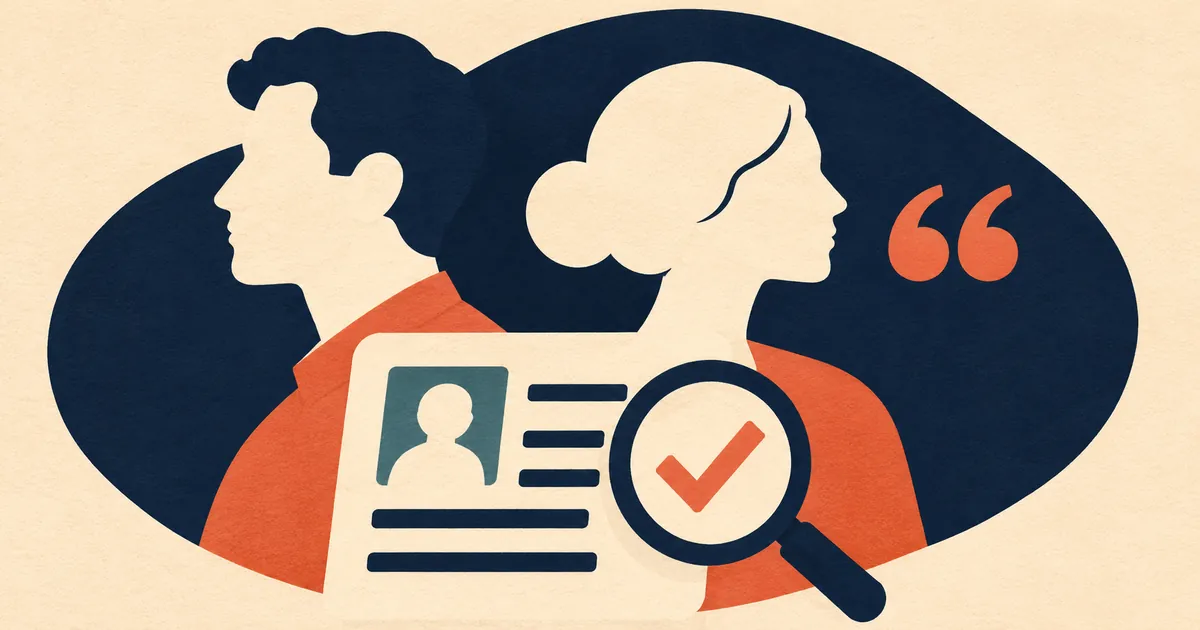
Short answer: First-party sources are best for what a person or organization says about itself. Independent sources are stronger for external verification and context. A careful profile needs both, clearly labeled, because neither category answers every kind of question.
First-Party vs Independent Sources for Profiles
The phrase official source can sound like a guarantee of truth. It is better understood as a source with direct responsibility for the statement. An official biography can establish the role a person publicly claims, while an independent award body can verify a nomination and a reported interview can preserve the person's own account with editorial context.
Limits of the first-party vs independent sources for profiles method
Avoid calling a source independent when it republishes a press release or affiliate biography. Independence concerns reporting and evidence, not merely a different domain name.
Evidence record for First-Party vs Independent Sources for Profiles
For First-Party vs Independent Sources for Profiles, begin with name the publisher and finish with preserve disagreement. The checkpoints below preserve the evidence and decision path for this specific task.
Name the publisher
Identify who controls the page and what relationship that publisher has to the subject.
Match source to claim
Use a team roster for participation, a publisher for a book record, and a first-party site for official links.
Separate statement from fact
Write that a person said something when the source is an interview and independent confirmation is unavailable.
Look for original reporting
Prefer named authors, direct documents, and explained methods over summaries that point only to other summaries.
Preserve disagreement
When credible sources conflict, show the dates and wording rather than silently choosing the convenient version.
First-Party vs Independent Sources for Profiles in practice
A creator's website may say she is a photographer and produces her own shoots. That supports a self-description of her public work. It does not independently prove revenue, audience size, or private biography. A profile can still use the statement if it says who made it and limits the conclusion to what the statement covers.
Decision test for first-party vs independent sources for profiles
Source independence is claim-specific. An employer can authoritatively describe a current role but is not independent coverage of its own employee. An interview can accurately preserve what the subject said without independently proving the statement. Write the relationship beside each citation, then ask whether the page reports direct knowledge, repeats another outlet, or offers external verification. The result should show readers which details are self-description, which are public records, and which have been checked by a publisher with no direct stake in the claim.
Related reading for First-Party vs Independent Sources for Profiles
source-checked public figure profiles show how the evidence labels work on real profile pages; Salma Hayek career guide traces acting and producing claims through named records; and Danny Trejo career profile connects interviews, a memoir, screen credits, and community work.
Sources used for First-Party vs Independent Sources for Profiles
Reference set for First-Party vs Independent Sources for Profiles: material supporting the profile research decisions on this page.