
Plan the build around wear time and venue rules
Make a wear test before adding surface detail. Put on the base layers, coat, footwear, headpiece, and any carried prop for the length of a typical journey through the venue. Record visibility, breathing comfort, heat, stair movement, sitting, drinking water, and how quickly the headpiece can be removed. A costume that photographs well for two minutes may still be unsafe or impractical for an event day.
Treat every prop as a venue and transport problem before treating it as a finishing problem. Check maximum dimensions, material restrictions, inspection rules, and whether public transport allows the item. Use lightweight, blunt, clearly artificial construction. The visual priority is the overall silhouette, so reducing weight or changing an internal support usually protects the design better than forcing a heavy replica through a long event.
- Confirm event and transport rules before buying prop materials.
- Test sight lines and quick removal with another person present.
- Place ventilation and hydration ahead of hidden surface accuracy.
- Photograph the silhouette before committing time to weathering.
Start by using the beginner cosplay planning guide to define the version, wear time, and finish line. Before buying the coat and wraps, compare drape, heat, recovery, and surface finish with the cosplay fabric selection guide.
Death Korps of Krieg cosplay key points
- Silhouette and proportion matter more than covering every surface with accessories.
- A costume respirator must never be represented as certified respiratory protection.
- The mask needs planned ventilation, clear sight lines, and a fast removal method.
- Exact uniform details vary across miniatures, editions, artwork, and specialist roles.
Choose one reference version
Death Korps imagery has accumulated across miniatures, books, promotional art, and game rules. A trooper, command figure, engineer, Death Rider, and veteran do not share every item. Save front, side, and back references for one role before buying materials. Record the source and date beside each image.
This prevents an expensive late-stage problem where an appealing shoulder piece from one design clashes with the helmet, coat, and webbing of another. A deliberate personal interpretation is fine, but it should be a choice rather than an accident.
Build the silhouette before the accessories
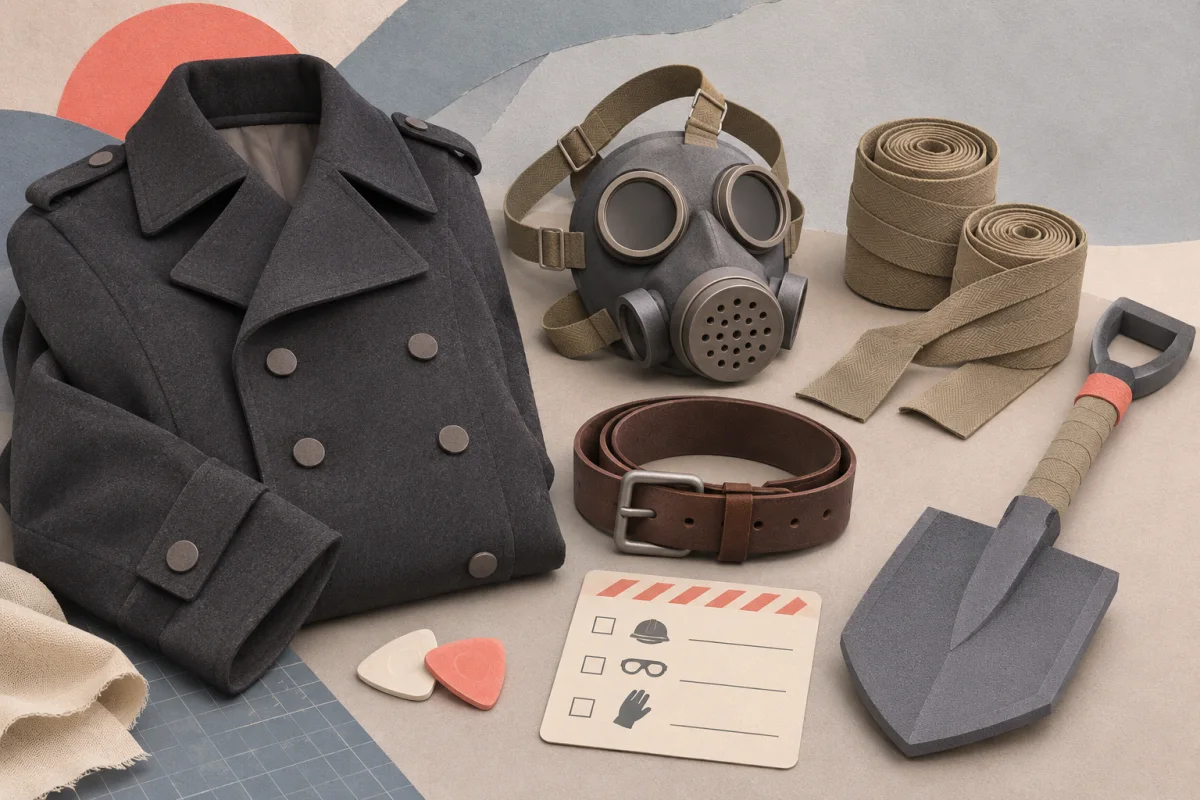
The most recognizable proportions are the long structured coat, enclosed head shape, circular eye lenses, wrapped or gaitered lower legs, practical boots, and waist webbing. Put on temporary versions of those pieces and take a full-body photograph from several meters away. If the outline reads clearly, small pouches and weathering can wait.
If it does not, adding more badges will not solve the underlying proportions. Check coat hem length, shoulder width, helmet scale, and the visual transition between coat, lower-leg wraps, and boots.
Treat the mask as the main safety project
A theatrical mask can restrict air flow, trap heat, fog lenses, reduce hearing, narrow peripheral vision, and make speech difficult. It is not a respirator for smoke, dust, chemicals, or infection control. Use breathable costume materials, screened ventilation openings, anti-fog planning, and straps that release quickly. Practice removing it with one hand.
Arrange a handler for crowded events, and never wear it while driving. If dizziness, headache, panic, or breathing difficulty appears, remove the mask and move to a safe area immediately.
Pre-event wear test
- Wear the complete costume for at least thirty minutes in a controlled place.
- Walk stairs, sit, drink water, communicate, and remove the mask without help.
- Photograph the costume in daylight and typical indoor lighting.
- Read the current venue, transit, and prop rules.
- Pack repair tape, spare fasteners, water, lens cloth, and a non-costume backup outfit.
Record a timed wear test before weathering
A photograph does not reveal heat, fogging, hearing loss, blocked movement, or slow removal. Use the cosplay measurement checklist to record fit points, then review the cosplay prop safety checklist before moving with a carried piece. Run the controlled test with another adult present and log observations at the start, after movement, and after removal.
Example log for a fictional test build
| Observation | Recorded result | Build decision |
|---|---|---|
| Lens fog | Clear at start, partly fogged after stair test | Increase safe ventilation and retest before paint |
| Headpiece removal | Two hands needed because one strap caught | Replace the release path and repeat with gloves |
| Coat movement | Hem contacted the heel on stairs | Shorten or control the back hem before lining |
The example is not a safety threshold or product test. Stop immediately for breathing difficulty, dizziness, panic, pain, loss of vision, or unsafe heat. Costume masks are not protective respirators. If the costume will be worn outdoors, the weatherproof cosplay guide explains how to test coatings, adhesives, dye transfer, and safe stop conditions before the event.
Build priority by visual impact
| Component | What makes it read | Safety check |
|---|---|---|
| Greatcoat | Long hem, broad collar, controlled blue-grey or charcoal value | Heat, movement, trip risk |
| Mask | Round lenses and an enclosed face silhouette | Air flow, fogging, quick removal |
| Helmet | Proportion compatible with the mask | Weight, secure fit, sight line |
| Lower legs | Puttees, gaiters, or a clean wrapped effect | Circulation and stair movement |
| Webbing | Belt and a few well-placed pouches | No trailing straps or hard pressure points |
| Prop | One simple oversized silhouette | Lightweight, blunt, venue approved |
Make the coat wearable
A heavy wool military coat can become exhausting indoors. For a convention build, a lighter wool blend, cotton twill, or lined synthetic suiting may preserve the broad shape with less heat. Add hidden movement room at the shoulders and back. Test stairs, sitting, kneeling, and reaching before finishing the lining.
Secure loose straps so they cannot catch on doors or other costumes. Weathering should use fabric-safe pigments and paint that will not shed onto venues, car seats, or nearby attendees.
Keep props clearly artificial
Use lightweight foam, hollow plastic, cardboard tube, or other event-safe construction. Avoid metal blades, sharpened tools, pressurized parts, realistic firing mechanisms, or anything that cannot pass the venue's prop inspection. Bright transport covers and a labeled storage bag reduce confusion outside the event. Some venues require colored tips, peace bonding, size limits, or complete prohibition.
Their current published rules override any generic online tutorial. Plan a costume that still reads well if the prop must remain at home.
Color and weathering without visual mud
Start with a restrained separation among coat, leather, mask, helmet, wraps, and metal-like surfaces. If every object is the same grey-brown, the costume disappears into one mass in photographs. Put the darkest value around the face and belt, keep the coat a step lighter, and preserve small clean edges where straps overlap fabric.
Weather high-contact zones logically: hems, knees, elbows, boot edges, and pouch corners. A few controlled marks communicate use better than covering the whole build with random black paint.
Use the lore as design context
Official Warhammer material describes Krieg as an irradiated world shaped by civil war, siege conditions, and a culture of sacrifice. That context explains the greatcoats, masks, entrenching tools, and austere presentation, but cosplay does not need to celebrate the setting's ideology. Avoid borrowing real extremist symbols or presenting fictional insignia as historical authenticity.
Keep the description clear that this is a costume based on a fictional regiment.
Compare this covered military silhouette with the different material and movement problems in the Lady Death cosplay guide. For a recognizable headwear reference with fewer full-body constraints, use the Arthur Morgan hat guide.
Questions that remain after the main answer
Is a surplus gas mask safe for cosplay?
Age, filters, rubber condition, and contamination history can be unknown. A theatrical mask built from known materials is usually the safer costume choice. Neither should be treated as certified protection without professional verification.
Which color is canon?
There is no single universal paint value across every official depiction. Choose a documented unit or artwork and keep your coat, armor, leather, and wraps distinct under the lighting where the costume will be seen.
Do I need a prop weapon?
No. The coat, mask, helmet, and leg treatment can carry the identity. A prop-free build is easier to transport and welcome at more venues.
Sources and how they were used
Official overview used for the fictional setting and uniform context.
Official historical overview used to distinguish the regiment's story from real military history.
Current official visual and role reference. Rules can change and are not reproduced here.
Explains why original artwork and safety-first construction guidance are used.
Correction or stronger source for Death Korps of Krieg cosplay?
Send the sentence from this Death Korps of Krieg cosplay guide and the strongest original source that addresses it. We record material changes without turning interpretation into fact.
Read the corrections process