
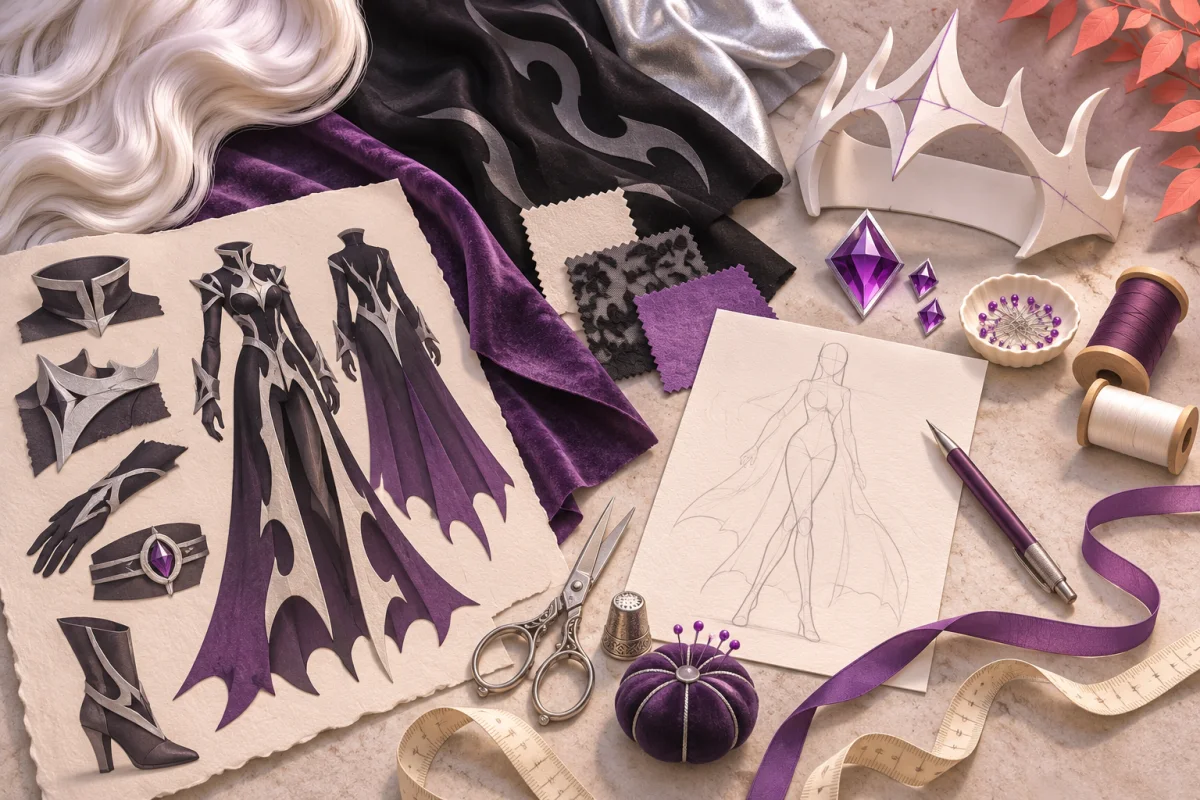
Choose one source version and test it in motion
Start with a dated reference board from one named comic issue, cover, licensed artwork, or other controlling version. Mark which details are visible in the source and which are construction choices made for the costume. This avoids combining incompatible crown shapes, fabric treatments, and accessories from several interpretations while describing the result as a single exact version.
Test the largest shapes while walking, sitting, turning, and posing. Long hair, capes, fitted garments, and carried props change position as soon as the wearer moves. Use temporary fasteners and inexpensive mock-up fabric before final construction. A strong result keeps the recognizable color blocks and silhouette while allowing safe steps, clear vision, secure attachment, and a fast way to remove anything that catches or overheats.
- Label the reference version on the build board.
- Separate visible source details from personal construction decisions.
- Mock up movement and attachment points before decorative finishing.
- Use blunt, lightweight props and check the event policy in writing.
Start by choosing the continuity and image
Lady Death has appeared under different publishers and creative periods, and Coffin Comics explicitly distinguishes its current continuity from the Avatar Press and Boundless period. A search result gallery can mix all of them without labels.
Select one cover, panel sequence, or official character image as the main reference and use other images only to understand hidden angles. Write the source on the board. This makes color, crown, neckline, armor, cape, and weapon decisions consistent and gives judges or photographers an accurate description of what you interpreted.
Build a recognition hierarchy
The costume needs a few large signals before it needs decorative trim. Long white hair creates the head and shoulder silhouette. Black and very pale materials create the central contrast. Silver or cool-grey edges define supernatural armor shapes, while violet can work as a controlled accent.
A crown, high collar, shoulder shape, gauntlets, or boot line can provide the angular cue. Rank those elements according to the chosen image. If the silhouette remains readable in a phone photo with the details blurred, the hierarchy is working.
Lady Death cosplay key points
- Lady Death has multiple publishing continuities and many costume variations.
- A source board should identify the publisher, title, issue, artist, and year.
- High contrast and crown or armor shape carry more recognition than exposed skin.
- Foam and thermoplastic props must remain blunt, lightweight, and venue compliant.
Reference board decisions
| Decision | Record | Why it prevents rework |
|---|---|---|
| Continuity | Publisher and story period | Stops incompatible costume eras from blending |
| Primary image | Title, issue, artist, year | Gives one authority for color and silhouette |
| Coverage plan | Base layer and movement limits | Prevents last-minute tape-only solutions |
| Wig | Length, tone, attachment, storage | Controls weight, tangles, and color shift |
| Armor | Material, thickness, attachment | Keeps sharp forms flexible and wearable |
| Prop | Venue rule, dimensions, transport state | Avoids refusal at entry |
Use a movement matrix before final attachments
Test the wig, crown, garment, armor, and prop as a system. Score each movement only after performing it in the complete mock-up: 2 means clear and stable, 1 means usable with a change, and 0 means stop and redesign.
| Movement | Wig and crown | Garment | Armor | Prop |
|---|---|---|---|---|
| Turn the head | Check tangles and pressure | Check collar contact | Check shoulder clearance | Park the prop first |
| Raise both arms | Check hair traps | Check lift and coverage | Check attachment load | Test one safe hold |
| Sit and stand | Move hair forward | Check seams and opacity | Check hip edges | Use a planned rest point |
| Use stairs | Keep sight lines clear | Control the hem | Check loose parts | Use a handler if needed |
Record the failed interaction
Do not write only “armor failed.” Note that the right shoulder point caught the wig during a head turn, or that the cape pulled the collar when sitting. A specific interaction leads to a specific repair.
Change one connection at a time
Shorten the wig section, move the attachment, soften an edge, or change the prop rest point, then repeat the same movement. This shows whether the change solved the problem without creating another one.
Adapt coverage without apologizing for it
Comic art often ignores gravity, movement, support, temperature, and the need to sit. A convention costume is an interpretation for a real body in a public environment. Add a bodysuit base, modesty panels, higher side coverage, opaque tights, dance briefs, or secure mesh where useful.
Repeat the original color blocks and edge shapes so the design remains recognizable. Good adaptation solves a construction problem; it does not make the costume less authentic. Test every pose you expect to use, including stairs and floor-level photographs.
Plan the wig as a wearable structure
Very long white wigs tangle, pull backward, hide costume details, and become hot. Choose a length you can transport and brush. Secure it with an adjustable wig cap, pins or clips appropriate for your hair, and a fit test that does not create headache pressure. Detachable wefts or a shorter base can make travel easier.
Use cool or neutral white based on the costume palette, then photograph it under warm indoor light. Store it in sections and carry a wide-tooth comb rather than trying to repair severe tangles in a crowded hallway.
Translate armor shapes into flexible layers
Draw each armor or crown piece as a flat pattern and mark where it must bend with the body. Thin foam, flexible thermoplastic, fabric-covered foam, or layered craft materials can create sharp-looking edges without dangerous weight. Round every point that could contact another person.
Use elastic, magnets backed by mechanical safety straps, snaps, or hidden hook-and-loop according to the load. A beautiful shoulder piece that blocks the arm or catches the wig will not survive a full event. Prototype in card before cutting the final material.
Make props safe and detachable
Swords, scythes, and supernatural accessories should be unmistakably artificial, light enough to hold without fatigue, and separable for transport. Use soft foam edges and avoid a rigid point at face height. A staff or blade should have a planned resting position so it is not laid across a walkway.
Check the venue's current dimensions, peace-bonding process, and material restrictions before construction. Prepare a prop-free pose set as well. The costume should still work if staff ask you to check or remove an accessory.
Photograph without copying a cover
A cover can guide palette and character attitude, but recreating its exact pose, camera angle, background, and layout produces a derivative imitation rather than an editorial interpretation. Create a new shot list based on the costume's shapes: three-quarter crown view, back silhouette, fabric-detail close-up, and a neutral full-body reference.
Credit the comic issue that informed the costume, the costume maker, photographer, and location. Do not imply endorsement by the publisher or use its logo as your own.
For a contrasting full-coverage build, compare the Death Korps of Krieg costume guide. The Arthur Morgan hat reference shows how one signature object can carry recognition with much less construction.
Costume fitting checklist
- Raise both arms, sit, kneel, turn the head, and climb stairs.
- Check opacity and attachment under direct flash and backlighting.
- Wear the wig long enough to reveal pressure points.
- Round armor corners and add backup attachment points.
- Prepare credits for the reference issue, maker, and photographer.
Questions that remain after the main answer
Which Lady Death costume is the definitive one?
There is no single outfit that covers every publication era and artist. A precise source choice is more accurate than calling a blended design definitive.
Does a Lady Death cosplay have to be revealing?
No. Recognition comes from the white hair, contrast, angular supernatural forms, and chosen accessories. Coverage can be adapted around comfort and venue context.
Where should a new reader start?
Coffin Comics currently recommends Chaos Rules as the beginning of its continuity and explains how it treats earlier publishing periods in its official FAQ.
Sources and how they were used
First-party continuity and recommended-reading information from the character's current publisher.
Primary destination for current titles, credits, and official reference material.
Our approach to original visuals, copyright, credits, and reader safety.
Correction or stronger source for Lady Death cosplay?
Send the sentence from this Lady Death cosplay guide and the strongest original source that addresses it. We record material changes without turning interpretation into fact.
Read the corrections process